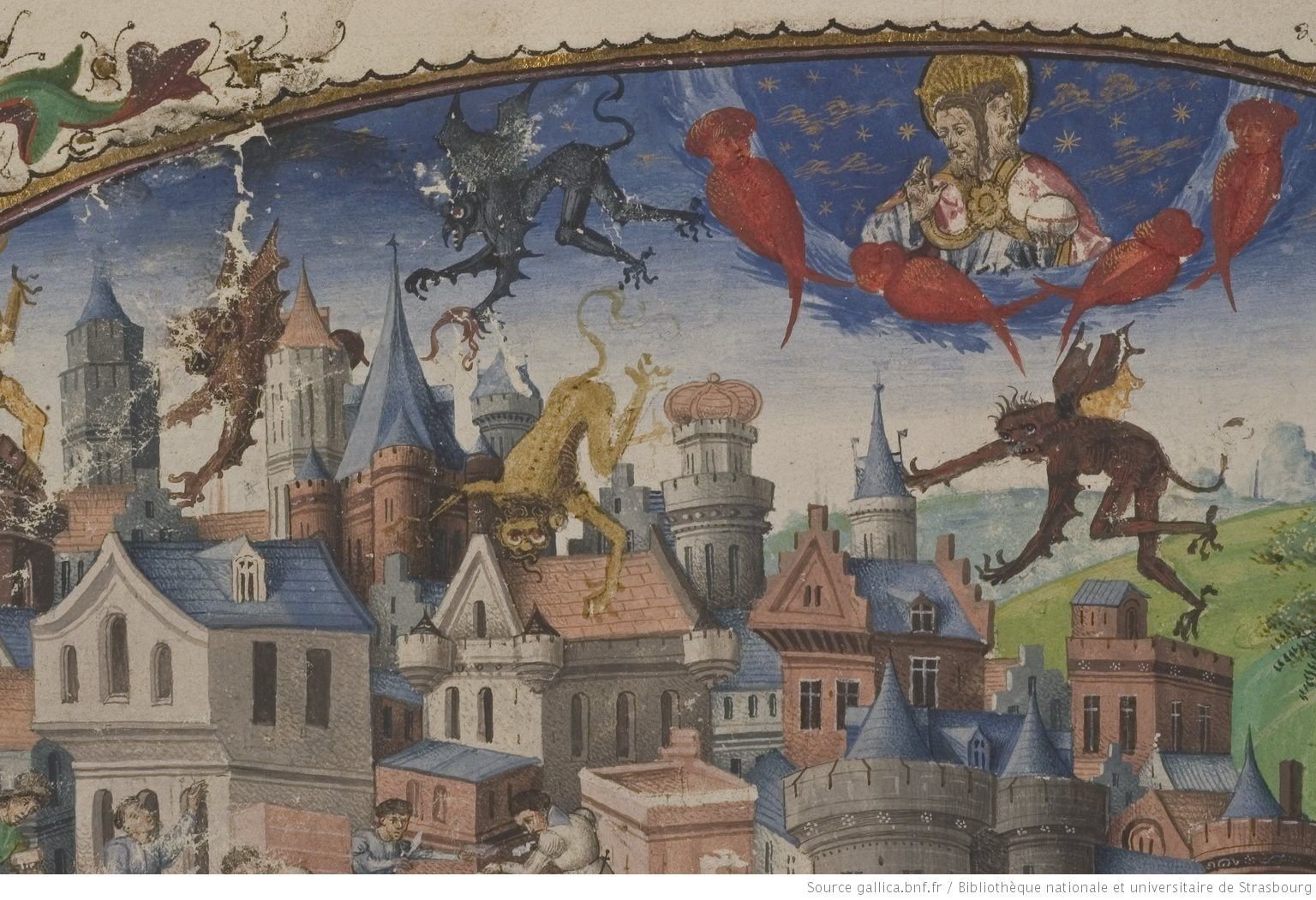
Image mise en avant : La Cité de Dieu (Saint Augustin)
Voir notamment sur le sujet :
- Du pasteur Pierre Courthial :
- Jean-Marc Berthoud :
- Jean-Marc Daumas :
- Jean Brun, Les origines intellectuelles de la Révolution française, Aix-en-Provence, 1988 [MP3]
Il y a incontestablement une manière chrétienne d’appréhender l’Histoire, avec un grand H. Dans la perspective réformée, l’Histoire est conçue comme les annales du Dieu souverain. Rien n’échappe à la providence divine. Comme le dit Calvin dans l’IC : « Les évènements quels qu’ils soient relèvent de la providence de Dieu. »
Saint Augustin propose une lecture théologique des grands nœuds de l’Histoire, des époques, dans son œuvre maitresse, La Cité de Dieu. Toute notre philosophie de l’Histoire se trouve exposée ici, dans les lignes principales.
À la suite de la chute de Rome, en 410, Augustin, obligé de défendre la foi chrétienne, met en évidence les fondements spirituels respectifs des deux cités, la cité terrestre, périssable, et la cité de Dieu, la seule qui ait les promesses de la vie éternelle.
« De fait, les deux cités sont mêlées et enchevêtrées l’une dans l’autre en ce siècle, jusqu’au jour où le jugement dernier les séparera. Je vais donc, dans la mesure où la grâce divine m’y aidera, exposer ce que j’estime devoir dire sur leur origine, leur développement, la fin qui les attend. Je servirai par là la gloire de la cité de Dieu qui, comparée ainsi à l’autre, se détachera par opposition avec un plus vif éclat (CD I.35).
Deux amours ont fait deux cités : l’amour de soi jusqu’au mépris de Dieu, la cité terrestre, l’amour de Dieu jusqu’au mépris de soi, la cité céleste.
L’une se glorifie en elle-même, l’autre dans le Seigneur. L’une demande sa gloire aux hommes ; pour l’autre, Dieu témoin de sa conscience est sa plus grande gloire. L’une dans sa gloire dresse la tête ; l’autre dit à son Dieu : « Tu es ma gloire et tu élèves ma tête. » (Ps 3, 4). L’une, dans ses chefs ou dans les nations qu’elle subjugue, est dominée par la passion de dominer ; dans l’autre on se rend mutuellement service par charité, les chefs en dirigeant, les sujets en obéissant. L’une en ses maîtres, aime sa propre force ; l’autre dit à son Dieu : « Je t’aimerai, Seigneur, toi ma force » (Ps 17.2).
Aussi, dans l’une les sages vivant selon l’homme ont recherché les biens du corps ou de l’âme ou les deux ; et ceux qui ont pu connaître Dieu ne l’ont pas glorifié comme Dieu ni ne lui ont rendu grâce, mais se sont égarés dans leurs vains raisonnements et leur cœur insensé s’est obscurci ; s’étant flattés d’être sages [c’est-à-dire s’exaltant dans leur sagesse sous l’emprise de l’orgueil], ils sont devenus fous : ils ont substitué à la gloire du Dieu incorruptible, des images représentant l’homme corruptible, des oiseaux, des quadrupèdes et des serpents [car à l’adoration de telles idoles, ils ont conduit les peuples ou les y ont suivi] ; et ils ont décerné le culte et le service à la créature plutôt qu’au Créateur qui est béni dans les siècles (Rm 1.21–24).
Dans l’autre au contraire, il n’y a qu’une sagesse, la piété qui rend au vrai Dieu le culte qui lui est dû, et qui attend pour récompense en la société des saints, hommes et anges, que Dieu soit tout en tous (Rm 1.25). »
La Cité de Dieu, XIV, 28
Calvin, de même, dit ceci, versets bibliques à l’appui, au sujet de la providence de Dieu qui conduit l’Histoire :
« Nous croyons non seulement que Dieu a créé toutes choses, mais qu’il les gouverne et les conduit, disposant de tout ce qui arrive dans le monde et réglant tout selon sa volonté.
Certes, nous ne croyons pas que Dieu soit l’auteur du mal ou que la culpabilité puisse lui en être imputée, puisqu’au contraire sa volonté est la règle souveraine et infaillible de toute droiture et de toute justice vrai. Mais Dieu dispose de moyens admirables pour se servir des démons et des impies, de telle sorte qu’il sait convertir en bien le mal qu’ils font et dont ils sont coupables.
Ainsi, en confessant que rien ne se fait sans la providence de Dieu, nous adorons avec humilité les secrets qui nous sont cachés, sans nous poser de questions qui nous dépassent. Au contraire, nous appliquons à notre usage personnel ce que l’Ecriture sainte nous enseigne pour être en repos et en sécurité ; car Dieu, à qui toutes choses sont soumises, veille sur nous d’un soin si paternel qu’il ne tombera pas un cheveu de notre tête sans sa volonté. Ce faisant, il tient en bride les démons et tous nos ennemis, de sorte qu’ils ne peuvent nous faire le moindre mal sans sa permission. »
Ps 104 ; Jb 34:14–15 ; Jn 5:17 ; Hé 1:3. Gn 27:20 ; 1 R 22:34 ; Ps 75:7–8 ; 115:3 ; 139:2–6, 13–18 ; Pr 21:1 ; Es 10:5–7 ; 45:7 ; Lm 3:37–38 ; Mt 10:29–30 ; Ac 14:17 ; 17:26–28 ; Jc 4:15. Jb 1:22 ; Ps 5:5 ; Os 13:9 ; Ga 5:19–21 ; 1 Jn 2:16 ; 3:8.Ps 45:7 ; 119. Gn 45:8 ; 50:20 ; Jb 12:13–25 ; Ac 2:23–24 ; 4:28 ; Rm 8:28. Rm 9:19–20 ; 11:33–34. Jb 1:21 ; Ps 10:14 ; 37:5 ; Rm 5:3–4 ; 8:28–29 ; 2 Co 4:7–18 ; 1 Th 5:18 ; Jc 1:1–3. Mt 6:25–34 ; 10:30 ; Lc 21:18 .Gn 3:15 ; Jb 1:12 ; 2:6 ; Es 45:1–8.
Confession de La Rochelle, Article 8
En anglais, il est impératif de lire les chapitres des Lectures on Calvinism du grand Abraham Kuyper. Voici.
Lectures on Calvinism : The Stone Lectures of 1898 – Abraham Kuyper
Sixth Lecture – Calvinism and the Future
The page numbering of the Eerdmans printed edition has been retained for the benefit of readers.
The Stone Lectures CALVINISM AND THE FUTURE Page 171
THE CHIEF PURPOSE of my lecturing in this country was to eradicate the wrong idea that Calvinism represented an exclusively dogmatical and ecclesiastical movement.
Calvinism did not stop at a church-order, but expanded in a life system, and did not exhaust its energy in a dogmatical construction. hut created a life- and world-view. and such a one as was, and still is, able to fit itself to the needs of every stage of human development, m every department of life. It raised our Christian religion to its highest spiritual splendor : it created a church order, which became the preformation of state confederation it proved to be the guardian angel of science ; it emancipated art : it propagated a political scheme, which gave birth to constitutional government, both in Europe and America ; it fostered agriculture and industry, commerce and navigation ; it put a thorough Christian stamp upon home-life and family-ties ; it promoted through its high moral standard purity in our social circles and to this manifold effect it placed beneath Church and State, beneath society and home-circle a fundamental philosophic conception strictly derived from its dominating principle, and therefore all its own.
This, of itself, excludes every idea of imitative and what the descendants of the old Dutch Calvinists as well as of the Pilgrim fathers have to do, is not to copy the past, as if Calvinism were a petrifaction. but to go back to the living root of the Calvinist plant, to clean and to water it. and so to cause it to bud and to blossom once more, now fully in accordance with our actual life in these modern times, and with the demands of the times to come.
This explains the subject of my final lecture. A new Calvinistic development needed by the wants of the future.
The Stone Lectures CALVINISM AND THE FUTURE Page 172
The prospect of this future does not present itself to us, as every student of sociology will acknowledge, in bright colors, I would not go so far as to assert that we are on the eve of universal social bankruptcy, but that the signs of the times are ominous admits of no denial. To be sure, in the control of nature and her forces, immense gains are being registered year by year, and the boldest imagination is unable to foretell to what heights of power in this respect the race may attain in the next half century. As a result of this, the comforts of life are increasing. World-intercourse and communication are constantly becoming more rapid and widespread. Asia and Africa, until recently dormant, gradually feel themselves drawn into the larger circle of stirring life. Aided by sport, the principles of hygiene exert a growing influence. Consequently, v e are physically stronger than the preceding generation. We live longer. And in combating the defects and infirmities that threaten and afflict our bodily life, surgical science makes us marvel at her achievements. In brief, the material. tangible side of life holds out the fairest of promises for the future.
And yet discontent makes itself heard, and the thinking mind cannot suppress its misgivings ; for, however high one may value the material things, they do not fill out the round of our existence as men Our personal life as men and citizens subsist not in the comforts that surround us, nor in the body, which serves us as a link with the outward world, but in the spirit that internally actuates us ; and in this inner consciousness we are becoming more and more painfully aware how the hypertrophy of our external life results in a serious atrophy of the spiritual. Not as if the faculties of thought and reflection, the arts of poetry and letters, were in abeyance. On the contrary, empirical science is more brilliant in her attainments than ever, universal knowledge spreads in constantly widening circles, and civilization, in Japan, for instance, is almost dazzled by her too rapid conquests. But even the intellect does not constitute the mind. Personality is seated more deeply in the hidden recesses of our inner being, where character is formed, .hence the flame of enthusiasm is kindled, where the moral foundations are laid, where love’s blossoms bud, whence spring consecration and heroism, and where in the sense for the Infinite, our time-bound existence reaches out unto the very gates of eternity.
The Stone Lectures CALVINISM AND THE FUTURE Page 173
It is in regard to this seat of personality that we hear on all sides the complaint of impoverishment, degeneracy, and petrifaction, The prevalence of this state of malaise explains the rise of a spirit like Arthur Schopenhauer’s ; and the wide acceptance of his pessimistic doctrine reveals to what a deplorable extent this fatal Sirocco has scorched already the fields of life. It is true, Tolstoi’s efforts show force of character, but even his religious and social theory is a protest along the whole line against the spiritual degeneracy of our race. Friedrich Wilhelm Nietzsche1 may give us offence by his sacrilegious mockery, still what else is his demand for the “Uebermensch” (over-man), but the cry of despair wrung from the heart of humanity by the bitter consciousness that it is spiritually pining away ? What is Social Democracy also but one gigantic protest against the insufficiency of the existing order of things ? Even Anarchism and Nihilism but too plainly demonstrate that there are thousands upon ten thousands who would rather demolish and annihilate everything, than continue to bear the burden of present conditions. The German author of the “Decadenz der Völker” descries nothing in the future but decay and social ruin. Even the sober-minded Lord Salisbury recently spoke of peoples and states for whose unceremonious burial preparations were already being made. How often has not the parallel been drawn between our time and the golden age of the Roman empire, when the external brilliancy of life likewise dazzled the eye, notwithstanding that the social diagnosis could yield no other verdict than “rotten to the very core.” And, although on the American continent, in a younger world, a relatively healthier tone of life prevails than in senescent Europe, yet this will not for a moment mislead the thinking mind. It is impossible for you to shut yourselves off hermetically from the old world, as you form no humanity apart, but are a member of the great body of the race. And the poison having once entered the system at a single point, in due time must necessarily pervade the whole organism.
Now the serious question with which we are confronted is whether we can expect that by natural evolution a higher phase of social life will develop out of the present spiritual decline. The answer
The Stone Lectures CALVINISM AND THE FUTURE Page 174
history supplies to this question is far from encouraging. In India, in Babylon, in Egypt, in Persia, in China and elsewhere, like periods of vigorous growth the have been succeeded by times of spiritual decadence ; and yet in not one of these lands has the downward course finally resolved itself in a movement towards higher things. All these nations to this day have persevered in their spiritual stagnation in the Roman empire alone has the dark night of boundless demoralization been broken by the dawn of a higher life. But this light did not arise through evolution ; it shone from the Cross of Calvary. The Christ of God appeared, and by His Gospel alone was the society of that time saved from certain destruction. And again. when towards the close of the middle ages Europe was threatened with social bankruptcy, a second resurrection from the dead and a manifestation of new vital power were witnessed, now among the peoples of the Reformation, but this time also not by way of evolution, but again through the same Gospel for which the hearts were thirsting, and whose truth was freely proclaimed as never before. What antecedents, then, does history furnish to lead us to expect in the present instance an evolution of life from death, whilst the symptoms of decomposition already suggest the bitterness of the grave ? Mohammed, it is true, in the seventh century succeeded in creating a stir among the dead bones throughout the entire Levant by throwing himself upon the nations as a second Messiah, greater even than the Christ. And assuredly if the coming of another Christ, surpassing in glory the Christ of Bethlehem, were possible, then the cure for moral corruption were found. Hence some, indeed, have been anxiously looking for the coming of some glorious “Universal Spirit,” who might again instill his vitalizing power into the heart-blood of the nations. But why dwell longer on such idle fancies ? Nothingcan possibly surpass the God-given Christ, and what we are to look for, instead of a second Messiah, is the second coming of the same Christ of Calvary, this time with His fan in His hand for judgment, not to open up for our sin-cursed life a new evolution, but to receive at its goal and solemnly to conclude the history of the world, Either this second coming, therefore, is near at hand, and what we are witnessing are the death-throes of humanity ; or a rejuvenation is still in store for us ; but if so, that rejuvenation can come only through the old and yet ever new Gospel which, at the
The Stone Lectures CALVINISM AND THE FUTURE Page 175
beginning of our era, and again at the time of the Reformation, has saved the threatened life of our race.
The most alarming feature, however, of the present situation is the lamentable absence of that receptivity in our diseased organism, which is indispensable to the effecting of a cure. In the Greco-Roman world such receptivity did exist ; the hearts opened spontaneously to receive the truth. To an even stronger degree this receptivity existed in the age of the Reformation, when large masses cried for the gospel. Then, as now, the body suffered from anemia, and blood-poisoning even had set in, but there was no aversion to the only effectual antidote. Now it is precisely this that distinguishes our modern decadence from the two preceding ones, that with the masses the receptivity for the Gospel is on the decrease, whilst with the scientists the positive aversion to it is on the increase. The invitation to bow the knee before Christ, as God, is met so often with a shrug of the shoulders, if not with the sarcastic rejoinder : “Fit for children and old women, not for us men!” The modern philosophy, which gains the day, considers itself in ever-increasing measure as having outgrown Christianity.
____________________
Therefore, first of all, the question must be answered what has brought us to this pass, a question deriving its paramount importance from the fact that only a correct diagnosis can lead to effective treatment. Now, historically, the cause of the evil is found in nothing else than in the spiritual degeneration which marked the close of the preceding century. The responsibility for this degeneration undoubtedly rests in part with the Christian churches themselves, not excepting those of the Reformation. Worn out by their struggle with Rome, these last churches had fallen asleep, had allowed leaf and flower to wither on their branches, and had apparently become forgetful of their duties in reference to humanity at large, and the whole sphere of human life. It is not necessary to enter upon this more fully. It may be taken for granted that towards the end of that century the general tone of life had become vapid and common-place, ignoble and base at heart. The eagerly devoured literature of that period furnishes the proof. By way of reaction against this, the proposal was then made by deistic and
The Stone Lectures CALVINISM AND THE FUTURE Page 176
atheistic philosophers, first in England, but afterwards chiefly in France on the part of the Encyclopedists, to place the whole of life on a new basis, turn upside down the existing order of affairs, and arrange a new world on the assumption that human nature continues in its uncorrupted state, This conception was an heroic one, and awakened response ; it struck some of the noblest chords of the human heart. But in the great Revolution of 1789 it was put into execution in its most dangerous form for in this mighty revolution, in this upheaval not only of political conditions, but even more of convictions, ideas, and usages of life, two elements should be sharply distinguished. In one respect it was an imitation of Calvinism, whilst in another respect it was in direct opposition to its principles. The great Revolution, it should not be forgotten, broke out in a Roman Catholic country, where first in the night of St. Bartholomew, and subsequently by the revocation of the edict of Nantes, the Huguenots had been slaughtered and banished. After this violent suppression of Protestantism in France, and other Roman Catholic countries, the ancient despotism had regained its ascendency, and to these nations all the fruits of the Reformation had been lost. This, by way of caricature of Calvinism, invited and compelled the attempt to strike for freedom by external violence, and to establish a pseudo-democratic state of affairs, which was to preclude for ever a return to despotism. Thus the French Revolution, by meeting violence with violence, crime with crime, strove after the same social liberty which Calvinism had proclaimed among the nations, but which had been attempted by Calvinism in the course of a purely spiritual movement. By this the French Revolution in a sense executed a judgment of God, the result of which affords, even to Calvinists, cause for rejoicing. The shades of De Coligny were avenged in the September murders of Mazas.
But this is only one side of the medal. Its reverse discloses a purpose directly opposed to the sound Calvinistic idea of liberty. Calvinism, by virtue of its profoundly serious conception of life, had strengthened and consecrated the social and ethical ties ; the French Revolution loosened and entirely unfastened them, detaching life not merely from the Church, but also from God’s ordinances, even from God Himself. Man as such, each individual henceforth, was to be his own lord and master, guided by his own free will and good pleasure. The train of life was to rush for
The Stone Lectures CALVINISM AND THE FUTURE Page 177
ward even more rapidly than heretofore, but no longer bound to follow the track of the divine commandments. What else could result than wreckage and ruin ? Enquire of the France of today what fruit the fundamental idea of her grand Revolution has yielded to the nation after its first century of free sway so rich in horrors, and the answer comes in a most pitiful tale of national decadence and social demoralization.
Humbled by the enemy from beyond the Rhine, internally rent by partisan fury, dishonored by the Panama cabal, and more still by the Dreyfus case, disgraced by its pornography, the victim of economic retrogression, stationary, nay, even decreasing in population, France, as has been well said by Dr. Garnier, a medical authority on the subject, has been led by egotism to degrade marriage, by lust to destroy family-life and presents today, in wide circles, the disgusting spectacle of men and women lost in unnatural sexual sin. I am aware that there are still thousands upon thousands of families in France living without reproach, who dearly grieve at the moral ruin of their country, but then these are the very circles which have resisted the false pretenses of the Revolution ; and, on the other hand, the almost bestialized circles are those that have succumbed to the first onset of Voltairianism.
From France this spirit of dissolution, this passion of wild emancipation, has spread among the other nations, especially through the medium of an infamously obscene literature, and infected their lives. Then nobler minds. particularly in Germany, perceiving what depth of wickedness had been reached in France, made the bold attempt of realizing this enticing and reducing idea of “emancipation from God” in a higher form while yet retaining its essence. Philosophers of the first rank, in a stately procession, each for himself constructed a cosmology endeavoring to restore a firm foundation to social and ethical relations, either by putting them on the basis of natural law, or by giving them an ideal substratum evolved from their own speculation. For a moment this attempt seemed to have a fair chance of success : for, instead of atheistically banishing God from their system, these philosophers sought refuge in Pantheism, and thus made it feasible to found the social structure, not as the French, on a state of nature or on the atomistic will of the individual, but on the processes of history and
The Stone Lectures CALVINISM AND THE FUTURE Page 178
the collective will of the race, unconsciously tending towards the highest goal. And, indeed, for more than half a century this philosophy has imparted a certain stability to life ; not that any real stability was inherent in the system themselves, but because the established order of law and strong political institutions in Germany lent the indirect support of tradition to the walls of an edifice which otherwise would have immediately collapsed. Even so, however, it could not prevent that in Germany also, the moral principles became more and more problematic, moral foundations more and more insecure, no other right than that of actual law received recognition ; and, however much German and French development might differ between themselves, both agreed in their aversion to, and rejection of, traditional Christianity. Voltaire’s “Ecrasez l’infâme” is already left far behind by Nietzsche’s blasphemous utterances on the Christ, and Nietzsche is the author whose works are being most eagerly devoured by the young modern Germany of our day.
After this manner, then, we in Europe at least, have arrived at what is called modern life, involving a radical breach with the Christian traditions of the Europe of the past. The spirit of this modern life is most clearly marked by the fact that it seeks the origin of man not in creation after the image of God, but in evolution from the animal. Two fundamental ideas are clearly implied in this : (1) that the point of departure is no longer the ideal or the divine, but the material and the low ; (2) that the sovereignty of God, which ought to be supreme, is denied, and man yields himself to the mystical current of an endless process, a regressus and processus in infinitum. Out of the root of these two fertile ideas a double type of life is now being evolved. On the one hand the interesting, rich, and highly organized life of University circles, attainable by the more refined minds only ; and at the side of this, or rather far beneath it, a materialistic life of the masses, craving after pleasure, but, in their own way, also taking their point of departure in matter, and likewise, but after their own cynical fashion, emancipating themselves from all fixed ordinances. Especially in our ever-expanding large cities this second type of life is gaining the upper hand, overriding the voice of the country districts, and is giving a shape to public opinion, which avows its ungodly
The Stone Lectures CALVINISM AND THE FUTURE Page 179
character more openly in each successive generation. Money, pleasure, and social power, these alone are the objects of pursuit ; and people are constantly growing less fastidious regarding the means employed to secure them. Thus the voice of conscience becomes less and less audible, and duller the lustre of the eye which on the eve of the French Revolution still reflected ‑some gleam of the ideal. The fire of all higher enthusiasm has been quenched, only the dead embers remain. In the midst of the weariness of life, what can restrain the disappointed from taking refuge in suicide ? Deprived of the wholesome influence of rest, the brain is over-stimulated and over-exerted till the asylums are no longer adequate for housing the insane. Whether property be not synonymous with theft, becomes a more and more seriously mooted question. That life ought to be freer and marriage less binding, is being accepted more and more on an established proposition. The cause of monogamy is no longer worth fighting for, since polygamy and polyandry are being systematically glorified in all products of the realistic school of art and literature. In harmony with this, religion is, of course, declared superfluous because it renders life gloomy. But art, art above all, is in demand, not for the sake of its ideal worth, but because it pleases and intoxicates the senses. Thus people live in time and for temporal things, and shut their ears to the tolling of the bells of eternity. The irrepressible tendency is to make the whole view of life concrete, concentrated, practical. And out of this modernized private life there emerges a type of social and political life characterized by a decadence of parliamentarism, by an ever stronger desire for a dictator, by a sharp conflict between pauperism and capitalism, whilst heavy armaments on land and on sea, even at the price of financial ruin, become the ideal of these powerful states whose craving for territorial expansion threatens the very existence of the weaker nations. Gradually the conflict between the strong and the weak has grown to be the controlling feature of life, arising from Darwinism itself, whose central idea of a struggle for life has for its mainspring this very antithesis. Since Bismarck introduced it into higher politics, the maxim of the right of the stronger has found almost universal acceptance. The scholars and experts of our day demand with increasing boldness that the common man shall bow to their authority. And the end can only be
The Stone Lectures CALVINISM AND THE FUTURE Page 180
that once more the sound principles of democracy will be banished, to make room this time not for a new aristocracy of nobler birth and higher ideals, bat for the coarse and overbearing kratistocracy of a brutal money power. Nietzsche is by no means exceptional, but proclaims as its herald the future of our modern life. And while the Christ, in divine compassion, showed heart-winning sympathy with the weak, modern life in this respect also takes the precisely opposite ground that the weak must be supplanted by the strong. Such, they tell us, was the process of selection to which we, ourselves, owe our origin, and such is the process which, in us and after us, must work itself out to its ultimate consequences.
____________________
Meanwhile,2 as observed above, it should not be forgotten that there flows in modern life a side current, of nobler origin. A host of high-minded men arose, who, shrinking from the uneasy chill of the moral atmosphere, and taking alarm at the brutality of the prevailing egotism, endeavored to put new warmth in life partly by means of altruism, partly by means of a mystical cult of the feelings, partly even by means of the name Christianity. Though in accord with the school of the French Revolution in their breach with Christian tradition and in their refusal to recognize any point of departure besides that of empiricism and rationalism, these men nevertheless, by accepting, as Kant does, a crass dualism, tried to escape from the fatal consequences of their principle. It is precisely from this dualism that they drew the inspiration for the many noble ideas elaborated in their theories, embodied in their poetry, conjured up before our imagination in touching novels, commended to our consciences in ethical treatises, and, let us never forget. realized not infrequently in the serious pursuit of life. With them conscience, side by side with the intellect, had maintained its authority, and that human conscience is so richly endowed, (geinstrumenteerd) by God. To the vigorous initiative of these men we owe the numerous sociological investigations and practical measures, which have allayed and alleviated so much suffering, and by an ideal altruism have put to shame the selfishness
The Stone Lectures CALVINISM AND THE FUTURE Page 181
in many a heart. Having a personal predisposition for mysticism, some of them claimed the right to emancipate the inner life of the soul from all restraints of criticism. To lose one’s self in the Infinite, and to feel the stream of the Infinite pulsate through the deepest recesses of the inner life, meant to them desirable piety. Others again especially theologians, –to a less extent divorced from Christianity by reason of their antecedents, office, or scholarly occupation, falling in with this altruism and mysticism, set themselves the task of so metamorphosing the Christ that He might continue to glitter from the throne of humanity, as the highest ideal of the modernized human heart. Each and all inspired by sincerity and inspiring by their ideal intent, these endeavors may be traced from Schleiermacher down to Ritschl.3 He, therefore, who would look down upon such men. would only dishonor himself. Much rather v. e ought to thank them for what they endeavored to save, also those women of noble aspirations, who by their character-novels, written in a similar Christian spirit, have counteracted so much that was base and have fostered so many precious germs. Even Spiritism, fraught with error though it be, has often received its impulse from the alluring hope that the contact with the eternal world. destroyed by criticism, could thus be reestablished through the medium of visions. Unfortunately, however boldly conceived this ethical dualism might be. and whatever bold metamorphoses this mysticism might indulge in, there always lurked behind it the naturalistic. rationalistic system of thought which the intellect had devised. They extolled the normal character of their cosmology over against the abnormalism of our belief : and the Christian religion, being abnormalistic in principle and mode of manifestation, inevitably lost ground to such an extent that some of our best men did not shrink from professing that they preferred not only Spiritism. hut Mohammedanism, and Schopenhauer or even Buddhism to the old evangelical faith. It is true that the entire phalanx of theologians from Schleiermacher to Pfleiderer continued to pay high honors to the name of Christ. but it is equally undeniable that this remained possible only by subjecting Christ and the Christian confession to ever bolder metamorphoses. A painful fact, but one
The Stone Lectures CALVINISM AND THE FUTURE Page 182
which becomes absolutely evident, if you compare the creed now current in these circles with the confession for which our Martyrs died.
Even confining ourselves to the Apostles” Creed, which for almost two thousand years substantially has been the common standard of all Christians, we find that the belief in God as the “Creator of heaven and earth” has been abolished ; for creation has been supplanted by evolution. Abolished also has been the belief in God the Son, as born of the Virgin Mary, through the conception from the Holy Ghost. Abolished further, with many, the belief in His resurrection and ascension and return to judgment. Abolished, finally, even the belief of the church in the resurrection of the dead, or at least in the resurrection of the body. The name of the Christian religion is still being retained, but in essence it has become a quite different religion in its principle, even of a diametrically opposite character. And when incessantly the charge is brought against us, that in point of fact the traditional Christ of the Church involves a complete metamorphosis of the genuine Jesus, whilst the modern interpretation has lifted the veil off the true character of the historical Jesus of Nazareth, we can but answer that, after all, historically, not this modern conception of Jesus of Nazareth, but the Church’s confession of the Christ is the one that has conquered the world ; and that century after century, the best and most pious of our race have paid homage to the Christ of tradition and rejoiced in Him as their Savior in the shadow of death.
Though desiring to be second to none, therefore, in sincere appreciation of what is noble in such attempts, I am fully settled in my conviction that no help is to be expected from that quarter. A theology which virtually destroys the authority of the Holy Scriptures as a sacred book ; which sees in sin nothing but a lack of development ; recognizes Christ for no more than a religious genius of central significance ; views redemption as a mere reversal of our subjective mode of thinking ; and indulges in a mysticism dualistically opposed to the world of the intellect, –such a theology is like a dam giving way before the first assault of the inrushing tide. It is a theology without hold upon the masses, a quasi-religion
The Stone Lectures CALVINISM AND THE FUTURE Page 183
utterly powerless to restore our sadly tottering moral life to even a temporary footing.
____________________
May more perhaps be expected from the marvelous energy displayed in the latter half of this century by Rome ? Let us not too hastily dismiss this question. Though the history of the Reformation has established a fundamental antithesis between Rome and ourselves, it would nevertheless be narrow-minded and shortsighted to underestimate the real power which even now is manifest in Rome’s warfare against Atheism and Pantheism. Only ignorance of the exhaustive studies of Romish philosophy and of Rome’s successful efforts in social life, could account for such a superficial judgment. Calvin in his day already acknowledged that, as against a spirit from the Great Deep, he considered Romish believers his allies. A so-called orthodox Protestant need only mark in his confession and catechism such doctrines of religion and morals as are not subject to controversy between Rome and ourselves, to perceive immediately that what we have in common with Rome concerns precisely those fundamentals of our Christian creed now most fiercely assaulted by the modern spirit. Undoubtedly on the points of the ecclesiastical hierarchy, of man’s nature before and after the Fall, of justification, of the mass, of the invocation of saints and angels, of the worship of images, of purgatory, and many others, we are as unflinchingly opposed to Rome as our fathers were. But does not current literature show that these are not now the points on which the struggle of the age is concentrated ? Are not the lines of battle drawn as follows : Theism over against Pantheism ; sin over against imperfection ; the divine Christ of God over against Jesus the mere man ; the cross a sacrifice of reconciliation over against the cross as a symbol of martyrdom ; the Bible as given by inspiration of God over against a purely human product ; the ten commandments as ordained by God over against a mere archaeological document ; the ordinances of God absolutely established over against an ever-changing law and morality spun out of man’s subjective consciousness ? Now, in this conflict Rome is not an antagonist, but stands on our side, inasmuch as she also recognizes and maintains the Trinity, the Deity of Christ, the Cross as an atoning sacrifice. the Scriptures as the Word of God. and the
The Stone Lectures CALVINISM AND THE FUTURE Page 184
Ten Commandments as a divinely-imposed rule of life. Therefore. let me ask ii Romish theologians take up the sword to do valiant and skillful battle against the same tendency that we ourselves mean to fight to the death, is it not the part of wisdom to accept the valuable help of their elucidation ? Calvin at least was accustomed to appeal to Thomas of Aquino. And I for my part am not ashamed to confess that on many points my views have been clarified through my study of the Romish theologians.
This, however, does not in the least involve that our hope for the future may be placed in Rome’s endeavor, and that we, idle ourselves, may await Rome’s victory. A rapid survey of the situation will suffice to convince us of the contrary. To begin with your own continent, can South America for a moment stand a comparison with the North ? Now in South and Central America the Roman Catholic Church is supreme. It has exclusive control in this territory, Protestantism not even counting as a factor. Here, then, is an immense field in which the social and political power. which Rome can bring to bear upon the regeneration of our race, can freely exert itself, a field, moreover, in which Rome is not a recent arrival, but which she has occupied for almost three centuries. The youthful development of the social organism of these countries has stood under her influence ; she has remained in control also of their intellectual and spiritual life since their liberation from Spain and Portugal. Moreover, the population of these States is derived from such European countries as have always been under the undisputed sway of Rome. The test, therefore, is as complete and fair as possible. Rut in vain do we look in those American Romish States for a life which elevates, develops energy, and exerts a wholesome influence outside. Financially they are weak, comparatively unprogressive in their economic conditions in their i political life they present the sad spectacle of endless internal strife : and, if one were inclined to form an ideal picture of the future of the world, he might almost do so by imagining the very opposite of what is the actual situation in South America. Nor can it be pleaded in excuse of Rome that this is due to exceptional circumstances, for in the first place this political backwardness is met with not only in Chili, but likewise in Peru, Brazil as well as in the Venezuelan Republic ; while, crossing from the New to the Old
The Stone Lectures CALVINISM AND THE FUTURE Page 185
World, we reach, in spite of ourselves, the same conclusion in Europe, also, the credit of all Protestant states is high, that of the Southern countries which are Roman Catholic, is at a painful discount. Economic and administrative affairs in Spain and Portugal. and not less than in Italy, offer cause for continual complaint. The outward power and outside influence of these states is visibly declining. And, what is more discouraging still, infidelity and a revolutionary spirit have made such inroads in these countries, that half of the population, though still nominally Romish, has in reality broken with all true religion. This may be seen in France, which is almost entirely Roman Catholic, and yet has voted time and again with overwhelming majorities against the advocates of religion. In fact we may say that. in order to appreciate the noble, energetic traits of the Romanists, one must observe them, not in their own countries where they are on the decline, but in the centre of Protestant North Germany, in Protestant Holland, and England, and in your own Protestant United States. In regions where, deprived of a controlling influence, they adjust themselves to the polity of others and concentrate their strength as an opposition party, under such leaders as Manning and Wiseman, Von Ketteler and Windthorst, they compel our admiration by the enthusiastic championship of their cause.
But even apart from this testimonium paupertatis furnished by Rome herself through the mismanagement in Southern Europe an
South America, where she has full sway, in the contest of the nations also her power and influence are visibly waning. The balance of power in Europe is now gradually passing into the hands of Russia, Germany, and England, every one of them non-Romish States, and on your own continent the Protestant North holds the supremacy. Since 1866 Austria has been continually retrogressing. and at the death of the present Emperor will be seriously threatened with dissolution. Italy has attempted to live beyond its resources : it strove to be a great, colonial, naval power, and the result is that it has brought itself to the verge of economic ruin. The battle of Addua dealt the deathblow to more than her colonial aspirations. Spain and Portugal have absolutely lost all influence on the social, intellectual, and political development of Europe. And France, which only fifty years ago, made all Europe tremble
The Stone Lectures CALVINISM AND THE FUTURE Page 186
at the unsheathing of her sword, is now herself anxiously scanning the Sibylline books of her future. Even from a statistical point of view, the power of Rome is all the while decreasing. Economic and moral depression has in more than one Romish country brought about a considerable decrease of the birthrate. Whilst in Russia, Germany, England, and the United States population is growing, it has in some Romish countries become almost stationary. Even now statistics give only the smaller half of Christendom to the Roman Catholic Church, and it is safe to predict that within the next half century its share will be less than forty per cent. However highly, therefore, I may be inclined to value the inherent power of Roman Catholic unity and scholarship for the defense of much we also count sacred, and though I do not see how we could repulse the attack of Modernism save by combined exertion, nevertheless there is not the slightest prospect that the political supremacy will ever again pass into Rome’s hands. And, even if this were to happen contrary to expectations, who could possibly rejoice as in the realization of his ideal, if he beheld the conditions now prevailing in Southern Europe and South America, reproduced elsewhere ?
We may, in fact, even put it more strongly : it would be a step backwards in the course of history. Rome’s world and life-view represents an older and hence lower stage of development in the history of mankind. Protestantism succeeded it, and hence occupies a spiritually higher standpoint. He who will not go backwards, but reaches after higher things, must therefore either stand by the world-view once developed by Protestantism, or, on the other hand, for this, too, is conceivable, point out a still higher standpoint. Now this is what the latter modern philosophy does indeed presume to do, acknowledging Luther as a great man for his time, but hailing in Kant and Darwin the apostles of a much richer gospel. But this need not detain us. For our own age, however great in invention, in the display of powers of mind and energy, has not advanced us a single step in the establishment of principles, has in no wise given us a higher view of life, and has yielded us neither greater stability nor greater soundness in our religious and ethical, that is, truly human existence. The solid faith of the Reformation it has bartered for shifting hypothesis ; and in
The Stone Lectures CALVINISM AND THE FUTURE Page 187
so far as it ventured upon a systematized and strictly logical life view it did not reach forward, but backward, to that heathen wisdom of pre-Christian times, of which Paul testified that God has put it to shame by the foolishness of the Cross. Let no one therefore say : Ye who, because history does not go backward, protest against a return to Rome, ye yourselves have no right to make a stand on Protestantism ; for after Protestantism came Modernism. The pertinence of such an objection must be denied, as long as my contention be not disproved, that the material advance of our century has nothing in common with advancement in the matter of ethical principles, and that what Modernism offers us is not modern, but rather very antique not posterior, but anterior to Protestantism, reaching back to the Stoa and to Epicurus.
____________________
Only along the lines of Protestantism, therefore, can a successful advance be attempted, and on those lines indeed salvation is sought at present, by two different tendencies, both of which must lead to bitter disappointment. The one of these is practical, the other mystical in character. Without hope of defence against modern criticism and still less against criticism of dogma, the former, the practical tendency, holds that Christians can do no better than fall back upon all manner of Christian works. Its devotees are at a loss what attitude to assume towards the Scriptures ; they have become themselves estranged from dogma ; but what is to prevent such hesitating believers from sacrificing their person and their gold to the cause of philanthropy, evangelism, and missions ! This even offers a threefold advantage : it unites Christians of all shades of opinion, alleviates much misery, and has a conciliatory attraction for the non-Christian world And, of course, this propagandism through action must be gratefully and sympathetically hailed. In the century that has passed, Christian activity was indeed far too limited ; and a Christianity that does not prove its worth in practice, degenerates into dry scholasticism and idle talk. It would be a mistake, however, to suppose that Christianity can be confined within the limits of such practical manifestation. Our Savior made whole the sick and fed the hungry, but the paramount thing in His ministry was, after all, that in strict allegiance to the Scriptures of
The Stone Lectures CALVINISM AND THE FUTURE Page 188
the old Covenant, He openly proclaimed His own Divinity and Mediatorship, the expiation of sins through His blood, and His coming to judgment. No central dogma, in fact, has ever been confessed by the Church of Christ which was not the intellectual definition of what Christ proclaimed about His own mission to the world, and about the world to which He was sent. He healed the sick body, but He even more truly bound up our spiritual wounds. He rescued us from Paganism and Judaism, and translated us into a wholly new world of convictions of which He Himself, as the God-ordained Messiah, constituted the center. Besides, as far as our dispute with Rome is concerned, we should not lose sight of the fact that in Christian works and devotion Rome still outstrips us. Nay, let us acknowledge without reserve that even the unbelieving world is beginning to rival us, and that in deeds of philanthropy, she tries more and more to overtake us. In missions, to be sure, unbelief does not follow in our footsteps ; but pray how can we continue to prosecute missions, unless we have a well-defined Gospel to preach ? Or is it possible to imagine anything more monstrous than so-called liberal missionaries preaching only humanity and colorless piety, and met by the pagan sages with the answer that they themselves in their cultured circles have never taught or believed anything else than just this modern humanism ?
Does perhaps the other tendency, the mystical one, possess stronger powers of defence ? What thinker or student of history would affirm this ? No doubt mysticism eradiates a fervor that warms the heart ; and woe betide the giant of dogma and the hero of action, who are strangers to its depths and tenderness. God created hand, head, and heart ; the hand for the deed, the head for the world, the heart for mysticism. King in deed, prophet in profession, and priest in heart, shall man in this threefold office stand before God, and a Christianity that neglects the mystic element grows frigid and congeals. We are, therefore, to be accounted fortunate whenever a mystic atmosphere envelops us, making us breathe the balmy air of spring. Through it life is made truer, deeper, and richer. But it would be a sad mistake to suppose that mysticism, taken by itself, can bring about a reversal in the spirit of the age. Not Bernard of Clairvaux but Thomas of Aquino, not Thomas a Kempis but Luther, have ruled the spirits of men.
The Stone Lectures CALVINISM AND THE FUTURE Page 189
Mysticism is, in its very nature, seclusive, and strives rather to avoid contact with the outside world. Its very strength lies in the indifferentiated life of the soul, and on this account it cannot take a positive stand. It flows along a subterranean bed and does not show sharply demarcated lines above the ground. What is worse, history proves that all one-sided mysticism has always become morbid, and has ultimately degenerated into a mysticism of the flesh, astounding the world with its moral infamy.
Accordingly, although I rejoice in the revival of both the practical and mystical tendencies, both will result in loss instead of gain, if they are expected to compensate for the abandonment of the Truth of Salvation Mysticism is sweet, and Christian works are precious, but the seed of the Church, both at the birth of Christianity and in the age of the Reformation, has beer. the blood of martyrs ; and our sainted martyrs shed their blood not for mysticism and not for philanthropic projects, but for the sake of convictions such as concerned the acceptance of truth and the rejection of error. To live with consciousness is man’s well-nigh divine prerogative, and only from the clear, unobscured vision of consciousness proceeds the mighty word that can make the times reverse their current. and cause a revolution in the spirit of the world. It is self-deception, therefore, and only self-deception, when these practical and mystical Christians believe they can do without a Christian life and world-view of their own. No one can do without that. Everyone who thinks he can abandon the Christian truths, and do away with the Catechism of Reformation, lends ear unawares to the hypotheses of the modern world-view and, without knowing how far he has drifted already, swears by the Catechism of Rousseau and Darwin.
____________________
Therefore, let us not stop half-way. As truly as every plant has a root, so truly does a principle hide under every manifestation of life. These principles are interconnected. and have their common root in a fundamental principle ; and from the latter is developed logically and systematically the whole complex of ruling ideas and conceptions that go to make up our life and world-view. With such a coherent world and life-view, firmly resting on its principle
The Stone Lectures CALVINISM AND THE FUTURE Page 190
and self consistent in its splendid structure, Modernism now confronts Christianity ; and against this deadly danger, ye, Christians cannot successfully defend your sanctuary, but by placing, in opposition to all this, a life- and worldview of your own, founded as firmly on the base of your own principle, wrought out with the same clearness and glittering in an equally logical consistency. Now this is not obtained by either Christian works or mysticism but only by going back, our hearts full of mystical warmth and our personal faith manifesting itself in abundant fruit, to that turning-point in history, and in the development of humanity which was reached in the Reformation. and this is equivalent to a return to Calvinism. There is no choice here. Socinianism died an inglorious death ; Anabaptism perished in wild revolutionary orgies. Luther never worked out his fundamental thought. And Protestantism, taken in a general sense, without further differentiation, is either a purely negative conception without content, or a chameleon-like name which the deniers of the God-Man like to adopt as their shield. Only of Calvinism can it be said that it has consistently and logically followed out the lines of the Reformation, has established not only Churches but also States, has set its stamp upon social and public life, and has thus, in the full sense of the word, created for the whole life of man a world of thought entirely its own.
I feel convinced that, after what I have said in my first lectures, no one will accuse me of underrating Lutheranism ; yet the present Emperor of Germany has no less than three times furnished an example of the evil after-effects of Luther’s apparently slight mistakes. Luther was misled into recognizing the Sovereign of the land as the head of the Established Church, and what have we, as a result of this, been called upon to witness from German’s eccentric Emperor ? First of all, that Stocker, the champion of Christian democracy, was dismissed from his court, merely because this bold defender of the freedom of the churches had so much as expressed the wish that the Emperor should abdicate his chief episcopate. Next, that at the sailing of the German squadron for China, Prince Henry of Russia was instructed to carry to the far orient not the “Christian” but the “imperial gospel.” More recently that he called upon his loyal subjects to be faithful in the
The Stone Lectures CALVINISM AND THE FUTURE Page 191
performance of their duties, urging as a motive that after death they were to appear before God … and His Christ ? … No ; but … before God … and the great Emperor. And finally, on the banquet of Porta Wesphalia, that Germany had to continue its labors undisturbedly under the blessing of peace, as enjoined, he concluded, by the outstretched hand of the great Emperor, who here stands above us. Ever bolder encroachment, it will be noticed, of Caesarism upon the essence of the Christian religion, These, as you see, are far from mere trifles ; rather, they touch principles of world-wide application, for which our forefathers in the age of the Reformation fought their great battles. To I am as averse as any man ; but in order to place for the defence of Christianity, principle over against principle, the world-view over against world-view, there lies at hand, for him who is a Protestant in bone and marrow, only the Calvinistic principle as the sole trustworthy foundation on which to build.
____________________
What, then, are we to understand by this return to Calvinism ? Do I mean that all believing Protestants should subscribe, the sooner the better, to the Reformed symbols, and thus all ecclesiastical multiformity be swallowed up in the unity of the Reformed church-organization ? I am far from cherishing so crude, so ignorant, so unhistorical a desire. As a matter of course, there is inherent in every conviction, in every confession, a motive for absolute and unconditional propagandism, and the word of Paul to Agrippa : “I would to God that with little or with much, not only you, but also all that hear me this day, might become such as I am,” must remain the heartfelt wish not only of every good Calvinist, but of every one who may glory in a firm immovable conviction. But so ideal a desire of the human heart can never be realized in this our dispensation. First of all, not one Reformed standard, not even the purest, is infallible as was the word of Paul. Then, again, the Calvinistic confession is so deeply religious, so highly spiritual that, excepting always periods of profound religious commotion, it will never be realized by the large masses, but will impress with a sense of its inevitability only a relatively small circle. Furthermore, our inborn one-sidedness will always necessarily lead to the manifestation
The Stone Lectures CALVINISM AND THE FUTURE Page 192
of the Church of Christ in many forms. And, last not least, absorption on a large scale by one Church of the members of another can only take place at critical moments in history. In the ordinary run of things eighty per cent of the Christian population die in the Church in which they were born and baptized. Besides, such an identification of my program with the absorption of one Church by another would be at variance with the whole tendency of my argument. Not ecclesiastically confined to a narrow circle, but as a phenomenon of universal significance. have I commended to you the Calvinism of history. Therefore, what I ask may in the main be reduced to the following four points : (1) that Calvinism shall no longer be ignored where it still exists, but be strengthened where its influence continues ; (2) that Calvinism shall again be made a subject of study in order that the outside world may come to know it ; (3) that its principles shall again be developed in accordance with the needs of our time, and consistently applied to the various domains of life ; and (4) that the Churches which still lay claim to confessing it, shall cease being ashamed of their own confession.
First, then, Calvinism should no longer he ignored where it still exists. but rather be strengthened where its historical influences are still manifest. A pointing out in detail. with even some degree of completeness, of the traces that Calvinism has everywhere left behind in social and political, in scientific and aesthetic life, would in itself demand a broader study than could he thought of in the rapid course of a lecture. Allow me. therefore, addressing an American audience, to point out a single feature in your own political life. I have already observed in my third lecture how in the preamble of more than one of your Constitutions, while taking a decidedly democratic view, nevertheless not the atheistic standpoint of the French Revolution, but the Calvinistic confession of the supreme sovereignty of God, has been made the foundation, at times even in terms, as I have pointed out, corresponding literally with the words of Calvin. Not a trace is to he found among you of that cynic anti-clericalism which has become identified with the very essence of the revolutionary democracy in France and elsewhere. And when your President proclaims a national day of thanksgiving, or when the houses of Congress assembled in Washington are
The Stone Lectures CALVINISM AND THE FUTURE Page 193
opened with prayer, it is ever new evidence that through American democracy there runs even yet a vein which, having sprung from the Pilgrim Fathers, still exerts its power at the present day. Even your common school system, inasmuch as it is blessed with the reading of Scripture and opening prayer, points, though with decreasing distinctness, to like Calvinistic origin. Similarly in the rise of your university education, springing for the larger part from individual initiative ; in the decentralized and autonomous character of your local governments ; in your strict and yet not nomistic Sabbath-observance ; in the esteem in which woman is held among you, without falling into the Parisian deification of her sex ; in your sense for domesticity ; in the closeness of your family ties ; in your championship of free speech, and in your unlimited regard for freedom of conscience ; in all this your Christian democracy is in direct opposition to the democracy of the French Revolution ; and historically also it is demonstrable that you owe this to Calvinism and to Calvinism alone. But, lo and behold, while you are thus enjoying the fruits of Calvinism, and while even outside of your borders the constitutional system of government as an outcome of Calvinistic warfare, upholds the national honor, it is whispered abroad that all these are to be accounted blessings of Humanism, and scarcely any one still thinks of honoring in them the after-effects of Calvinism, the latter being believed to lead a lingering life only in a few dogmatically petrified circles. What I demand then, and demand with an historic right, is that this ungrateful ignoring of Calvinism shall come to an end ; that the influence it has exerted shall again receive attention where it still remains stamped upon the actual life of today ; and that, where men of a wholly different spirit would unobservedly divert the current of life into French revolutionary or German pantheistic channels, you on this side of the water. and we on our side, should oppose with might and main such falsification of the historic principles of our life.
That we may be enabled to do so, I contend in the second place, for an historical study of the principles of Calvinism. No love without knowledge ; and Calvinism has lost its place in the hearts of the people. It is being advocated only from a theological point of view, and even then very one-sidedly, and merely as a side is
The Stone Lectures CALVINISM AND THE FUTURE Page 194
The cause of this I have pointed out in a previous lecture. Since Calvinism arose, not from am abstract system, but from life itself, it never was in the century of its prime presented as a systematic whole. The tree blossomed and yielded its fruit, but without any one having made a botanic study of its nature and growth. Calvinism, in its rise, rather acted than argued. But now this study may no longer be delayed. Both the biography and biology of Calvinism must now be thoroughly investigated and thought out, or, with our lack of self-knowledge, we shall be side-tracked into a world of ideas that is more at discord than in consonance with the life of our Christian democracy, and cut loose from the root on which we once blossomed so vigorously.
Only through such study will there become possible what I named in the third place : the development of the principles of Calvinism in accordance with the needs of our modern consciousness, and their application to every department of life. I do not exclude theology from this ; for theology, too, exercises its influence upon life in all its ramifications ; and it is, therefore, sad to see how even the theology of the Reformed Churches has in so many a country come under the sway of wholly foreign systems. But, at all events, theology is only one of the many sciences that demand Calvinistic treatment. Philosophy, psychology, aesthetics, jurisprudence, the social sciences, literature, and even the medical and natural sciences, each and all of these, when philosophically conceived, go back to principles, and of necessity even the question must be put with much more penetrating seriousness than hitherto, whether the ontological and anthropological principles that reign supreme in the present method of these sciences are in agreement with the principles of Calvinism, or are at variance with their very essence.
Finally, I would add to these three demands –historically justified as it seems to me still a fourth, that those Churches which lay claim to professing the Reformed faith, shall cease being ashamed of this confession. You have heard how broad my conception and how wide my views are, even in the matter of ecclesiastical life. In free development only do I see the salvation of this Church-life. I exalt multiformity and hail in it a higher stage of development. Even for the Church that has the purest confession, I would not dispense with the aid of other Churches in order that
The Stone Lectures CALVINISM AND THE FUTURE Page 195
its inevitable one-sidedness may thus be complemented. But what has always filled me with indignation was to behold a Church or to meet the office-bearer of a Church, with the flag furled or hidden under the garb of office, instead of being thrown out boldly to display its glorious colors in the breeze. What one confesses to be the truth, one must also dare to practice in word, deed, and whole manner of life. A Church Calvinistic in origin and still recognizable by its Calvinistic confession, which lacks the courage, nay rather which no longer feels the impulse to defend that confession boldly and bravely against all the world, such a Church dishonors not Calvinism but itself. Albeit the Church reformed in bone and marrow may be small and few in numbers, as Churches they will always prove indispensable for Calvinism ; and here also the smallness of the seed need not disturb us, if only that seed be sound and whole, instinct with generative and irrepressible life.
____________________
And thus my final lecture is rapidly drawing to its end. But before I close, I feel nevertheless that one question continues to press for an answer. which accordingly I shall not refuse to face, the question, namely, at what I am aiming in the end : at the abandonment or at the maintenance of the doctrine of election. Thereunto allow me to contrast with this word Election another word that differs from it in a single letter. Our generation turns a deaf ear to Election, but grows madly enthusiastic over Selection. How, then, may we formulate the tremendous problem that lies hidden behind these two words, and in what particular do the solutions of this problem, as represented by these two, almost identical formulas, differ ? The problem concerns the fundamental question : Whence are the differences ? Why is not all alike ? Whence is it that one thing exists in one state, another in another ? There is no life without differentiation, and no differentiation without inequality. The perception of difference the very source of our human consciousness. the causative principles of all that exists and grows and develops, in short the mainspring of all life and thought. I am therefore justified in asserting that in the end every other problem may be reduced to this one problem : Whence are those differences ? Whence is the dissimilarity, the heterogeneity of existence,
The Stone Lectures CALVINISM AND THE FUTURE Page 196
of genesis, and consciousness ? To put it concretely, if you were a plant you would rather be a rose than mushroom ; if insect, butterfly rather than spider ; if bird, eagle rather than owl ; if a higher vertebrate, lion rather than hyena ; and again, being man, richer than poor, talented rather than dull-minded, of the Aryan race rather than Hottentot or Kaffir. Between all these there is differentiation, wide differentiation. Everywhere then differences, differences between the one being and the other ; and that, too, such differences as involve in almost every instance, preference. When the hawk rends and tears the dove, whence is it that these two creatures are thus opposed to, and different from each other ? This is the one supreme question in the vegetable and animal kingdom, among men, in all social life, and it is by means of the theory of Selection that our present age attempts to solve this problem of problems, Even in the single cell it posits differences, weaker and stronger elements. The stronger overcomes the weaker, and the gain is stored up in a higher potency of being. Or, should the weaker still maintain its subsistence, the difference will be manifest in the further course of the struggle itself.
Now the blade of grass is not conscious of this, and the spider goes on entrapping the fly, the tiger killing the stag, and in those cases the weaker being does not account to itself for its misery. But we men are clearly conscious of these differences, and by us therefore the question cannot be evaded, whether the theory of Selection be a solution calculated to reconcile the weaker, the less richly endowed creature, with its existence. It will be acknowledged that in itself this theory can but incite to a more furious struggle, with a lasciate ogni speranza, voi che’ntrate for the weaker being. Against the ordinance of faith that the weaker shall succumb to the stronger, according to the system of election, no struggle can avail. The reconciliation, not springing from the facts, would therefore have to spring from the idea. But what is here the idea ? Is it not this, that, where these differences have once become established, and highly differentiated beings appear, this is either the result of chance, or else the necessary consequence of blind natural forces ? Now, are we to believe that suffering humanity will ever become reconciled to its suffering by such a solution ? Nevertheless I welcome the progress of this theory of Selection ; and
The Stone Lectures CALVINISM AND THE FUTURE Page 197
I admire the penetration and power of thought of the men who commend it to us. Not forsooth, on account of what it urges upon us as a truth ; but because it has mustered courage to attack once more the most fundamental of all problems, and thus in point of profundity reaches the same depth of thought, to which Calvin boldly descended.
For this is precisely the high significance of the doctrine of Election that, in this dogma, as long as three centuries ago, Calvinism dared to face this same all-dominating problem, solving it, however, not in the sense of a blind selection stirring in unconscious cells, but honoring the sovereign choice of Him Who created all things visible and invisible. The determination of the existence of all things to be created, of what is to be camellia or buttercup, nightingale or crow, hart or swine, and, equally among men, the determination of our own persons, whether one is to be born as girl or boy, rich or poor, dull or clever, white or colored, or even as Abel or Cain, is the most tremendous predestination conceivable in heaven or on earth ; and still we see it taking place before our eyes every day, and we ourselves are subject to it in our entire personality ; our entire existence, our very nature, our position in life being entirely dependent on it. This all-embracing predestination, the Calvinist places, not in the hand of man, and still less in the hand of a blind natural force, but in the hand of Almighty God, Sovereign Creator and Possessor of heaven and earth ; and it is in the figure of the potter and the clay that Scripture has from the time of the Prophets expounded to us this all-dominating election. Election in creation, election in providence, and so election also to eternal life ; election in the realm of grace as well as in the realm of nature. Now, when we compare these two systems of Selection and Election, does not history show that the doctrine of Election has century upon century, restored peace and reconciliation to the hearts of the believing sufferer ; and that all Christians hold election as we do, in honor, both in creation and in providence ; and that Calvinism deviates from the other Christian confessions in this respect only, that, seeking unity and placing the glory of God above all things, it dares to extend the mystery of Election to spiritual life, and to the hope for the life to come ?
The Stone Lectures CALVINISM AND THE FUTURE Page 198
This then is what Calvinistic dogmatic narrowness amounts to. Or rather, for the times are too serious for irony or jest, let every Christian, who cannot yet abandon his objections, at least put this all-important question to himself : Do I know of another solution of this fundamental world-problem enabling me better to defend my Christian faith, in this hour of sharpest conflict, against renewed Paganism collecting its forces and gaining day by day ? Do not forget that the fundamental contrast has always been, is still, and will be until the end : Christianity and Paganism, the idols or the living God. So far there is a deeply felt truth in the drastic picture drawn by the German Emperor, representing Bud&ism as the coming enemy. A closely drawn curtain hides the future ; but Christ has prophesied to us on Patmos the approach of a last and bloody conflict, and even now Japan’s gigantic development in less than forty years has filled Europe with fear for what calamity might be in store for us from the cunning “yellow race” forming so large a proportion of the human family. And did not Gordon testify that his Chinese soldiers, with whom he defeated the Taipings, if only well drilled and officered, made the most splendid soldiers he ever commanded ? The Asiatic question is in fact of most serious import. The problem of the world took its rise in Asia, and in Asia it will find its final solution ; and, both in technical and material development, the issue has shown that heathen nations, as soon as they awake, and arise from their lethargy, rival us almost instantly.
Of course, this danger would be far less menacing in case Christendom, in both the Old and the New World, stood united around the Cross, shouting songs of praise to their King, and ready as in the days of the crusades to advance to the final conflict. But how when pagan thought, pagan aspiration, pagan ideals are gaining ground even among us and penetrating to the very heart of the rising generation ? Have not the Armenians, just because the conception of Christian solidarity has become so sadly weakened, been basely and cravenly abandoned to the fate of assassination ? Has not the Greek been crushed by the Turk, while Gladstone, the Christian statesman, politically a Calvinist to the very core, who had the courage to brand the Sultan “Great Assassin,” has departed from among us ? Accordingly radical determination must
The Stone Lectures CALVINISM AND THE FUTURE Page 199
be insisted upon. Half-measures cannot guarantee the desired result. Superficiality will not brace us for the conflict. Principle must again bear witness against principle, world-view against world-view, spirit against spirit. And here, let him who knows better speak, but I for one know of no stronger and no firmer bulwark than Calvinism, provided it be taken in its sound and vigorous formation,
And if you retort, half mockingly, am I really naive enough to expect from certain Calvinistic studies a reversal in the Christian world-view, then be the following my answer : The quickening of life comes not from men : it is the prerogative of God, and it is due to His sovereign will alone, whether or not the tide of religious life rise high in one century, and run to a low ebb in the next. In the moral world, too, we have at one time spring, when all is budding and rustling with life, and again, the cold of winter, when every vital stream congeals, and all religious energy is petrified.
Now the period in which we are living at present, is surely at a low ebb religiously.
Unless God send forth His Spirit, there will be no turn, and fearfully rapid will be the descent of the waters. But you remember the Aeolian Harp, which men were wont to place outside their casement, that the breeze might wake its music into life. Until the wind blew, the harp remained silent, while, again, even though the wind arose, if the harp did not lie in readiness, a rustling of the breeze might be heard, but not a single note of ethereal music delighted the ear. Now, let Calvinism be nothing but such an Aeolian Harp, –absolutely powerless, as it is, without the quickening Spirit of God –still we feel it our God-given duty to keep our harp, its strings tuned aright, ready in the window of God’s Holy Zion, awaiting the breath of the Spirit.
________________________________
1. (Ed.) F. W. Nietzsche, 1844–1900, German Philosopher ; died insane. Author of Thus Spake Zarathustra.
2. (Ed.) The following paragraph has been revised after the Dutch original.
3. (Ed.) Albrecht Ritschl, 1822–1889. German theologian.